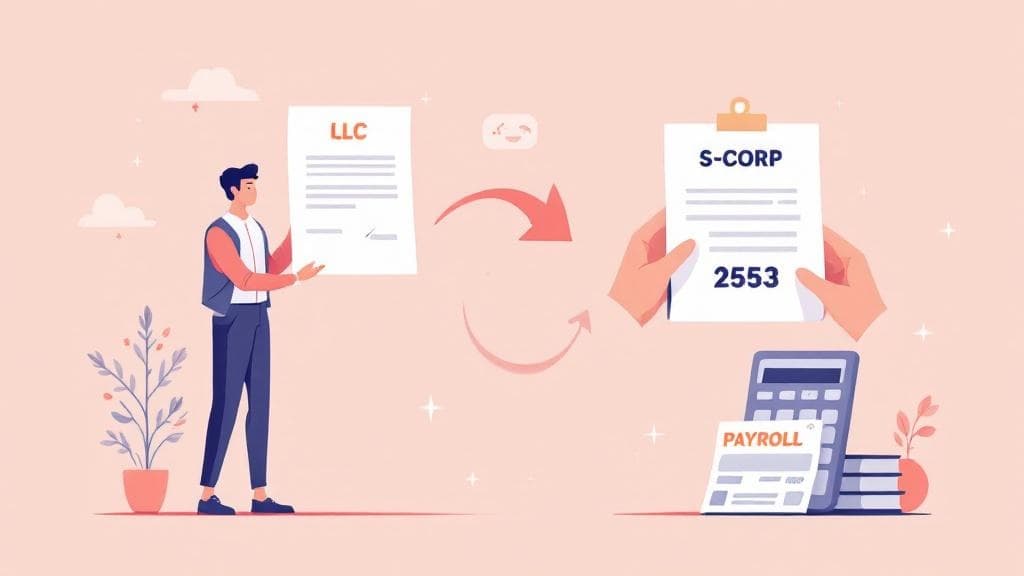
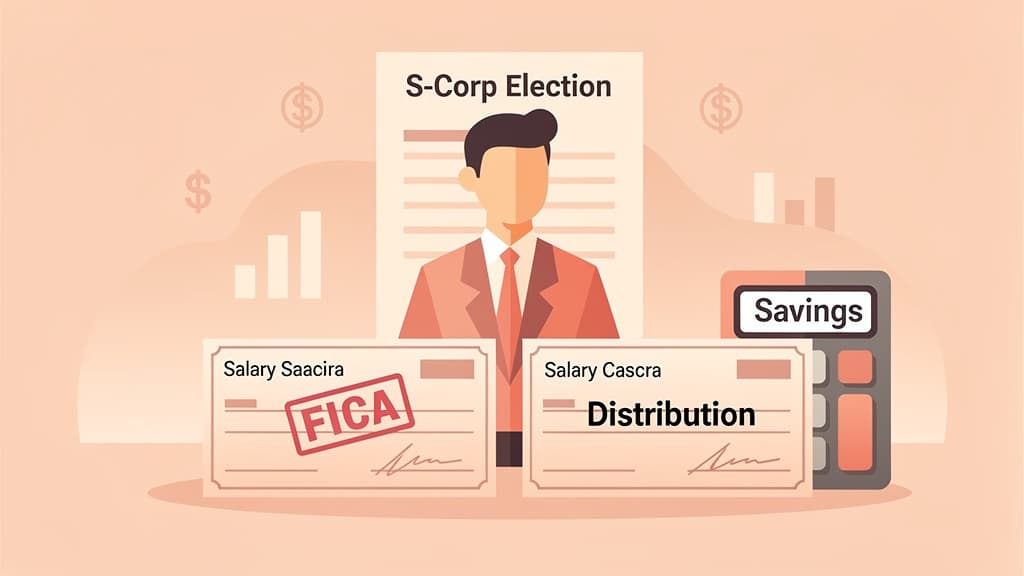
To convert an LLC to an S corporation, you file IRS Form 2553 by 2 months and 15 days after the start of the tax year, which is March 16, 2026 for a calendar-year 2026 election. The LLC keeps its legal structure; only its federal tax treatment changes, so profit above a reasonable salary stops paying the 15.3% self-employment tax. Missed the deadline? You can still get S-corp status for the year you wanted under Rev. Proc. 2013-30 late-election relief, filed up to 3 years and 75 days after the intended effective date if you had reasonable cause.
Key takeaways:
- Form 2553 deadline: March 16, 2026 for calendar-year 2026 status (2 months and 15 days after the tax year starts)
- What changes: nothing legally; the LLC just files Form 1120-S instead of Schedule C and pays FICA only on the owner's salary
- When it pays off: roughly $50,000-$60,000 of consistent net profit, where SE-tax savings beat the $1,500-$4,000 of added payroll and filing cost
- Late-election relief (Rev. Proc. 2013-30): treats a late Form 2553 as timely within 3 years and 75 days if you intended to be an S-corp, had reasonable cause, and reported income consistently
- Past 3 years and 75 days: the only path left is a private letter ruling, which costs thousands in IRS user fees and rarely pays off
- Reasonable salary is mandatory: a too-low salary gets distributions reclassified as wages (see Watson, 2012)
What is an S-Corp election? An LLC files Form 2553 to be taxed as an S-Corporation. The LLC's legal structure doesn't change, only its tax treatment. You remain an LLC under state law but file an 1120-S corporate tax return with the IRS.
2026 Key Numbers:
| Item | Details |
|---|
| Form 2553 deadline | March 16, 2026 (for calendar-year 2026 S-Corp status) |
| Alternative deadline | Within 2 months and 15 days of forming your LLC |
| SE tax rate | 15.3% (12.4% Social Security + 2.9% Medicare) |
| Social Security wage base | $184,500 (2026) |
| Late election relief | Rev. Proc. 2013-30 (up to 3 years 75 days late) |
| Minimum recommended net profit | $50,000+ |
Tax savings example: An LLC with $120,000 net profit elects S-Corp status. The owner pays herself a $60,000 salary and takes $60,000 as distributions.
Without the S-Corp election: $120,000 × 92.35% × 15.3% = $16,960 in self-employment tax. With the election and a $60,000 salary: $60,000 × 7.65% (employee FICA) plus $60,000 × 7.65% (employer FICA) equals $9,180 in payroll tax. Annual savings: $7,780 ($16,960 − $9,180), before payroll and filing costs.
Legal basis: IRC §1361 (S-Corp definition), IRC §1362 (S-Corp election), Form 2553, Rev. Proc. 2013-30 (late election relief)
The S-Corp election adds costs and complexity, payroll processing, quarterly payroll tax filings, and a separate corporate tax return (Form 1120-S). These costs typically run $1,500 to $5,000 per year, depending on your accountant and payroll provider.
For the election to produce net savings, you generally need:
- Net profit of $50,000 or more (some advisors say $40,000)
- Consistent income: not just one good year
- Ability to pay a reasonable salary and still have meaningful distributions
Additional S-Corp costs run $1,600-$3,800 a year: payroll service ($500-$1,200), the Form 1120-S return ($800-$2,000), and a bookkeeping increase ($300-$600). The SE tax you save equals (net profit − reasonable salary) × 92.35% × 15.3%. The election pays off once that saved SE tax exceeds your added costs.
Example at different profit levels:
| Net Profit | Reasonable Salary | Distribution | SE Tax Saved | Additional Costs | Net Benefit |
|---|
| $40,000 | $35,000 | $5,000 | $712 | $2,500 | -$1,788 |
| $60,000 | $40,000 | $20,000 | $2,849 | $2,500 | +$349 |
| $80,000 | $45,000 | $35,000 | $4,987 | $2,500 | +$2,487 |
| $100,000 | $50,000 | $50,000 | $7,124 | $2,500 | +$4,624 |
| $150,000 | $65,000 | $85,000 | $12,112 | $2,500 | +$9,612 |
The savings grow as income increases because a larger share is taken as distributions (not subject to payroll tax). Use the S-Corp salary calculator to run your own numbers.
The election doesn't make sense for everyone:
- Net profit under $40,000: the additional costs eat up the savings
- Highly variable income: you might set a salary you can't afford to pay in a slow month
- Multiple owners with different ownership classes: S-Corps can only have one class of stock
- Non-US owners: S-Corp shareholders must be US citizens or residents
- More than 100 shareholders: S-Corps are limited to 100 shareholders
- Planning to raise venture capital: investors typically require C-Corp structure
Your LLC must meet all S-Corp requirements (IRC §1361):
For a calendar-year LLC wanting S-Corp status for 2026:
Deadline: March 16, 2026 (2 months and 15 days after January 1)
Note: March 15 falls on a Sunday in 2026, so the deadline shifts to Monday, March 16.
If you're forming a new LLC mid-year, you have 2 months and 15 days from the formation date. For example:
| LLC Formation Date | Form 2553 Deadline |
|---|
| January 1, 2026 | March 16, 2026 |
| April 1, 2026 | June 15, 2026 |
| July 1, 2026 | September 14, 2026 |
| October 1, 2026 | December 15, 2026 |
Filing early: You can also file Form 2553 at any time during the preceding tax year. So filing in October 2025 for a January 1, 2026 effective date is valid.
The form itself is two pages. Here's what you'll need:
Part I, Election Information:
- Line A: Your LLC's EIN
- Line E: Effective date of election (usually January 1 of the tax year)
- Line F: Tax year (calendar year for most LLCs)
- Line G: Number of shares issued (for single-member LLCs, enter "100 units" or "1 membership interest")
Shareholder Consent (columns J-N):
Every LLC member must sign and provide their:
- Name and address
- Social Security Number
- Shares/percentage owned
- Tax year end
- Signature and date
Part II, Selection of Fiscal Year (most filers skip this, it's only for non-calendar year elections)
Part III, Qualified Subchapter S Trust (QSST) Election (only if a trust is a shareholder)
Where to file: Mail or fax to the IRS service center for your state. Find the correct address in the Form 2553 instructions.
By mail: Department of the Treasury, Internal Revenue Service Center (address depends on your state)
By fax: Fax numbers are listed in the form instructions (faster processing, recommended)
Online: Form 2553 cannot be filed electronically as of 2026.
The IRS will send a confirmation letter (CP261) within 60 days of receiving your Form 2553. If you don't receive confirmation, call the IRS Business & Specialty Tax Line at (800) 829-4933.
Keep a copy of everything, the signed form, your fax confirmation (if faxed), and the IRS confirmation letter. You'll need these if the election is ever questioned.
If you missed the March 16, 2026 deadline, you may still qualify for late election relief under Revenue Procedure 2013-30.
You must meet ALL of the following:
- The entity intended to be classified as an S-Corp as of the intended effective date
- The entity had reasonable cause for failing to file on time
- The entity and all shareholders reported income consistently with S-Corp status on all affected returns
- No more than 3 years and 75 days have passed since the intended effective date
Write "FILED PURSUANT TO REV. PROC. 2013-30" at the top of Form 2553. Include a statement explaining:
- Why the election wasn't filed on time
- That the entity has been operating as an S-Corp
- That all shareholders have reported income consistently
Common accepted reasons for late filing:
- Accountant failed to file the form
- Owner wasn't aware of the deadline
- Form was mailed but never received by the IRS
- Incorporated mid-year and miscalculated the deadline
Priya formed Devi Design LLC in January 2024 and assumed her accountant had filed the S-corp election. In June 2026, preparing her 2025 return, she discovers Form 2553 was never filed. She wanted S-corp status from January 1, 2025.
- Intended effective date: January 1, 2025
- 3-years-and-75-days window: January 1, 2025 plus 3 years and 75 days runs to about March 16, 2028, so in June 2026 Priya is well inside the window
- Reasonable cause: "My accountant failed to file the election" is an accepted reason
- Consistency: Priya and the LLC must report 2025 income the way an S corporation would, so she attaches her first Form 1120-S for 2025 to the late election
Priya writes "FILED PURSUANT TO REV. PROC. 2013-30" across the top of Form 2553, completes Part IV with her reasonable-cause statement, signs as the sole shareholder, and files it with her first Form 1120-S for 2025. The IRS accepts the election retroactive to January 1, 2025, and she keeps that year's self-employment-tax savings. For the section-by-section mechanics of the form, see Form 2553 S-Corp Election Guide.
If more than 3 years and 75 days have passed, you'll need to request a Private Letter Ruling (PLR) from the IRS. This costs thousands of dollars in IRS user fees (the fee scales with your gross income) plus professional fees, and takes 6-12 months. It's rarely worth it unless the tax savings are substantial.
Once your LLC elects S-Corp status, you must pay yourself a salary that the IRS considers "reasonable" for the work you perform. You can't pay yourself $10,000 and take $140,000 as distributions, the IRS will reclassify the distributions as wages and assess back payroll taxes, plus penalties.
The IRS doesn't publish a fixed number. Instead, they look at several factors:
- Training and experience required for the role
- Duties and responsibilities you perform
- Comparable salaries for similar positions in your industry and location
- Time and effort you devote to the business
- Compensation history: what you and others have been paid
- Dividend history: a large ratio of distributions to salary raises red flags
The IRS and Tax Courts have used these resources to determine reasonable salary:
- Bureau of Labor Statistics (BLS) salary data
- Robert Half Salary Guide
- Glassdoor, Salary.com, and PayScale data
- Industry-specific surveys
Rule of thumb: Many CPAs recommend setting salary at 40-60% of net profit for active owners. This isn't a legal rule, but it's a defensible position in most cases.
Examples:
| Net Profit | Reasonable Salary Range | Distribution Range |
|---|
| $60,000 | $35,000-40,000 | $20,000-25,000 |
| $80,000 | $40,000-50,000 | $30,000-40,000 |
| $100,000 | $45,000-60,000 | $40,000-55,000 |
| $150,000 | $60,000-80,000 | $70,000-90,000 |
| $200,000 | $75,000-100,000 | $100,000-125,000 |
Use the S-Corp salary calculator to find your optimal split.
If the IRS determines your salary is unreasonably low, they can:
- Reclassify distributions as wages: you'll owe back payroll taxes (both employee and employer shares)
- Assess a negligence penalty: 20% of the underpayment
- Charge interest: from the date the payroll taxes were originally due
- Impose failure-to-deposit penalties: for not making timely payroll tax deposits
Court case reference: In Watson v. Commissioner (2012), an accountant paid himself $24,000 salary on $200,000+ net income. The Tax Court ruled this was unreasonable and reclassified distributions as wages. In Radtke v. United States (1990), a shareholder who took zero salary had all S-Corp income reclassified as wages.
Once your election is approved, you need payroll in place. This is not optional, the IRS requires that S-Corp owner-employees receive a W-2.
- Payroll provider: Gusto, ADP Run, OnPay, or Paychex are common choices ($40-100/month)
- State unemployment insurance (SUI) account: register with your state's labor department
- Workers' compensation: required in most states, even for single-employee S-Corps
| Tax | Rate | Who Pays | Filed On |
|---|
| Social Security | 6.2% each | Employee + Employer | Form 941 (quarterly) |
| Medicare | 1.45% each | Employee + Employer | Form 941 (quarterly) |
| Federal unemployment (FUTA) | 6% on first $7,000 (usually 0.6% after state credit) | Employer | Form 940 (annual) |
| State unemployment | Varies by state | Employer | State form (quarterly) |
| Federal income tax withholding | Per W-4 | Employee | Form 941 (quarterly) |
After converting to S-Corp, your annual filing requirements increase:
| Form | What It Is | Deadline |
|---|
| Form 1120-S | S-Corp income tax return | March 16, 2026 (15th day of 3rd month) |
| Schedule K-1 | Each shareholder's share of income | Issued with 1120-S |
| Form 940 | Annual FUTA tax return | January 31 |
| Form 941 | Quarterly payroll tax return | Quarterly |
| W-2 | Employee wage statement | January 31 |
| Form 1040 | Personal tax return (with K-1 income) | April 15 |
For the complete 2026 filing calendar, including K-1 distribution, payroll deposits, and estimated-tax dates, see S-Corp Tax Deadlines 2026.
Let's work through a complete example comparing LLC (sole proprietorship) tax treatment versus S-Corp tax treatment for 2026.
As a Default LLC (Sole Proprietorship):
| Default LLC (sole proprietorship) | Amount |
|---|
| Net profit | $100,000 |
| Self-employment tax ($92,350 × 15.3%) | $14,130 |
| Deductible half of SE tax | ($7,065) |
| Adjusted gross income | $92,935 |
| Standard deduction (single, 2026) | ($16,100) |
| QBI deduction (20%, taxable-income limited) | ($15,367) |
| Taxable income | $61,468 |
| Federal income tax (2026 brackets, approx.) | ≈$8,240 |
| Plus self-employment tax | $14,130 |
| Total federal tax | ≈$22,370 |
As an S-Corp (with $50,000 salary):
| S-Corp election ($50,000 salary) | Amount |
|---|
| Gross receipts | $100,000 |
| Officer salary | ($50,000) |
| Employer payroll tax (7.65%) | ($3,825) |
| S-Corp net income (K-1 distribution) | $46,175 |
| Total payroll tax (employee + employer, 15.3%) | $7,650 |
| AGI (salary $50,000 + K-1 $46,175) | $96,175 |
| Standard deduction (single, 2026) | ($16,100) |
| QBI deduction (20% of $46,175) | ($9,235) |
| Taxable income | $70,840 |
| Federal income tax (2026 brackets, approx.) | ≈$10,300 |
| Owner's total burden (income tax + $7,650 payroll) | ≈$17,950 |
Annual tax savings: ≈$22,370 − ≈$17,950 = ≈$4,400. Subtract additional costs (roughly $2,500 for payroll and extra filing) for a net savings of about $1,900.
At $150,000 net profit with a $65,000 salary, the net savings jump to approximately $8,000-$10,000 after costs. The higher the profit, the larger the savings, because a greater share flows through as distributions rather than salary. For the savings mapped out at $75K, $100K, $150K, and $200K, see How an S Corp Reduces Self-Employment Tax, and check your exact numbers with the self-employment tax calculator.
Problem: Converting when net profit is under $40,000, or in a year with unpredictable income.
Impact: The additional costs of payroll, the separate 1120-S tax return, and compliance requirements exceed the SE tax savings. You actually pay more overall.
Solution: Wait until you have at least $50,000 in consistent net profit for two or more years before electing. Run the numbers with the S-Corp salary calculator before deciding.
Problem: Paying yourself a minimal salary (e.g., $20,000 on $150,000 net income) to maximize the distribution.
Impact: The IRS reclassifies distributions as wages, assesses back payroll taxes, adds penalties, and charges interest. The cost can exceed what you "saved."
Solution: Set salary at 40-60% of net profit or benchmark against BLS data for your role. Document your reasoning.
Problem: Learning about the S-Corp election in April after the March 16 deadline has passed.
Impact: You can't elect S-Corp status for the current year (without late relief), so you miss a full year of tax savings.
Solution: If you're close to the deadline, fax Form 2553 immediately, faxing provides a faster confirmation than mail. If you've missed it, file under Rev. Proc. 2013-30 for late election relief.
Problem: Making the S-Corp election but never setting up payroll, or only running payroll at year-end.
Impact: S-Corp owner-employees must receive regular salary payments (at least quarterly, ideally monthly or bi-weekly). A lump-sum December salary raises red flags and may trigger an audit.
Solution: Set up payroll before the election effective date. Run payroll at least monthly throughout the year.
Problem: Focusing only on federal tax savings without checking state rules.
Impact: Some states (like California) impose additional taxes on S-Corps, California charges a 1.5% franchise tax on net income plus an $800 minimum tax. New York City doesn't recognize S-Corp status at all for city tax purposes.
Solution: Check your state's S-Corp tax rules before electing. In some high-tax states, the state-level costs reduce or eliminate the federal savings. Review the S-Corp vs LLC guide for state-specific considerations.
The LLC-to-S-Corp conversion is one of the highest-impact tax decisions a small business owner can make, but only if the numbers work. Jupid helps you get those numbers right.
Automatic profit tracking. Jupid connects to your bank accounts and categorizes transactions with 95.9% accuracy, giving you a real-time view of net profit. No more guessing whether you've hit the $50,000 threshold.
Tax savings estimates. Based on your actual income data, Jupid shows you the projected SE tax savings from an S-Corp election versus your current structure.
Year-round monitoring. As your income fluctuates, Jupid updates your projected tax liability, so you can see whether the S-Corp election continues to make sense.
AI accountant on WhatsApp and iMessage. "Should I elect S-Corp status this year?", ask Jupid's AI accountant and get a data-driven answer based on your actual financials.
The S-Corp election can save you thousands per year, but only if you're above the break-even point. Connect your accounts and see your numbers.
The S-Corp election is one of the few tax strategies that can save a five-figure amount with relatively simple paperwork. But it's not free, you're trading SE tax savings for payroll complexity and an additional tax return. Run the numbers for your specific situation, get the timing right, and make sure your salary passes the "reasonable" test. For most LLC owners earning $50,000 or more in consistent net profit, the math works clearly in your favor.
Disclaimer: This article is for informational purposes only and does not constitute legal or tax advice. Tax laws change frequently; consult a qualified tax professional for advice specific to your situation. Tax Year: 2026. Last Updated: July 7, 2026.