


Tax FilingMar 21, 2026
October 15 Tax Extension Deadline 2026: What's Due and What Happens If You Miss It
October 15, 2026 is the final deadline for extended tax returns. Learn what's due, who must file, and the penalties for missing it.
Read more
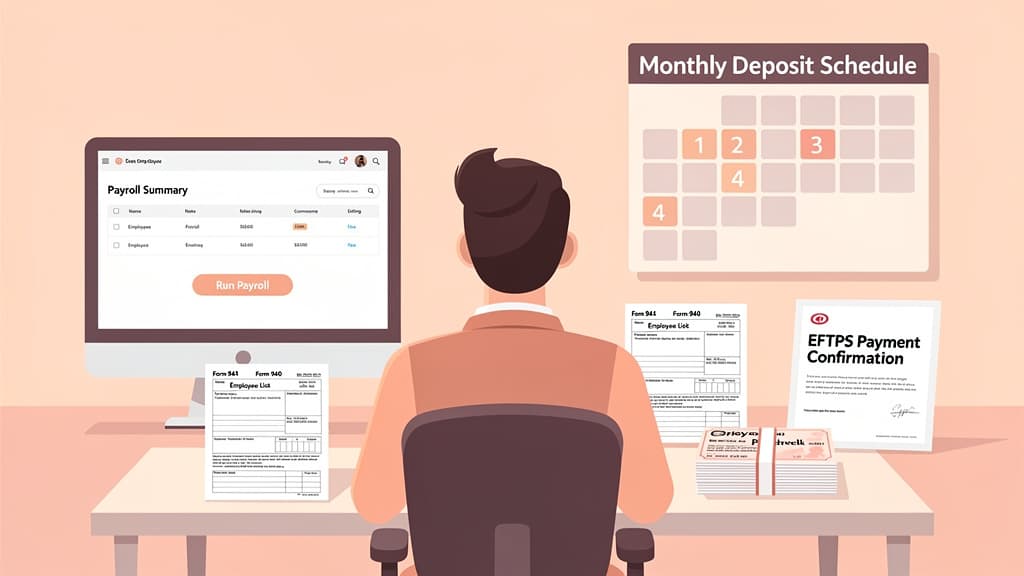
The next federal payroll tax deadline is July 31, 2026: Form 941 for the second quarter of 2026, covering wages paid April 1 through June 30. After that, the Q3 Form 941 is due November 2, 2026 (October 31 falls on a Saturday), and the Q4 Form 941, the annual Form 940, and W-2s are all due February 1, 2027 (January 31 is a Sunday). If you deposited all payroll taxes on time and in full for the quarter, the IRS gives you 10 extra days to file, which pushes the Q2 filing to August 10, 2026.
Key takeaways:

| Deadline | What's Due | Who It Applies To |
|---|---|---|
| Apr 30, 2026 | Form 941 (Q1), deadline passed | Employers with employees |
| Jul 31, 2026 | Form 941 (Q2) | Employers with employees |
| Nov 2, 2026 | Form 941 (Q3) | Employers with employees |
| Feb 1, 2027 | Form 941 (Q4) | Employers with employees |
| Feb 1, 2027 | Form 940 (annual FUTA) | Employers who pay $1,500+ or had employee in 20+ weeks |
| Feb 1, 2027 | W-2 / W-3 to SSA and employees | All employers |
| 15th of following month | Monthly payroll tax deposits | Monthly depositors |
| Within 1-3 business days | Semi-weekly payroll tax deposits | Semi-weekly depositors |
Note: October 31, 2026 falls on a Saturday and January 31, 2027 falls on a Sunday, so the Q3 Form 941, Q4 Form 941, Form 940, and W-2/W-3 deadlines all shift to the next business day.
Missed the Q1 filing on April 30? File now. The late-filing penalty is 5% of the unpaid tax per month, up to 25%, and it keeps accruing until the return is in.
Legal basis: IRC §3111, IRC §3402, IRC §6302, IRC §6656
For a full view of all federal business tax deadlines, see the 2026 Tax Deadline Calendar.
Payroll taxes are employment taxes that fund Social Security, Medicare, and federal unemployment insurance. Unlike income tax, which is based on total earnings and deductions, payroll taxes are flat-rate taxes applied to wages. Both employers and employees share the burden — except for FUTA, which is employer-only.
| Tax | Employer Rate | Employee Rate | Wage Base |
|---|---|---|---|
| Social Security (OASDI) | 6.2% | 6.2% | $184,500 |
| Medicare (HI) | 1.45% | 1.45% | No cap |
| Additional Medicare | — | 0.9% | Wages over $200,000 |
| FUTA | 6.0% (0.6% after credit) | — | $7,000 |
Combined FICA rate: The employer pays 7.65% (6.2% + 1.45%) on each employee's wages up to the $184,500 Social Security wage base for 2026, and 1.45% on wages above that. The employee pays the same, plus an Additional Medicare Tax of 0.9% on wages exceeding $200,000. The employer does not pay the Additional Medicare Tax — it's employee-only.
Federal income tax withholding is not technically a "payroll tax," but it's deposited on the same schedule and reported on the same forms (Form 941). When the IRS refers to your "payroll tax liability" for deposit purposes, they mean the combined total of withheld income tax, the employee share of FICA, and the employer share of FICA.
FUTA (the Federal Unemployment Tax Act) is a separate tax reported on Form 940. The statutory rate is 6.0% on the first $7,000 of each employee's wages, but employers in states with approved unemployment programs receive a 5.4% credit, reducing the effective rate to 0.6%. That's a maximum of $42 per employee per year.
Form 941 is the workhorse of payroll tax compliance. Most employers file it four times a year to report wages paid, tips, federal income tax withheld, and both the employer and employee shares of Social Security and Medicare taxes.
Any employer who pays wages subject to federal income tax withholding or Social Security and Medicare taxes must file Form 941 — with one exception. If the IRS has notified you that you're eligible to file Form 944 (Employer's Annual Federal Tax Return), you file once a year instead of quarterly. Form 944 is available to employers whose annual payroll tax liability is $1,000 or less. You cannot choose Form 944 on your own; the IRS must designate you as a Form 944 filer.
Form 941 is due on the last day of the month following the end of each quarter: April 30, July 31, October 31, and January 31. When that day lands on a weekend or legal holiday, the deadline moves to the next business day, which shifts two of the deadlines for 2026 wages.
| Quarter | Wages Paid During | Filing Deadline |
|---|---|---|
| Q1 | January 1 – March 31, 2026 | April 30, 2026 |
| Q2 | April 1 – June 30, 2026 | July 31, 2026 |
| Q3 | July 1 – September 30, 2026 | November 2, 2026* |
| Q4 | October 1 – December 31, 2026 | February 1, 2027* |
*October 31, 2026 falls on a Saturday and January 31, 2027 falls on a Sunday, so both deadlines shift to the next business day.
If you've deposited all taxes for the quarter on time and in full, you get an extra 10 calendar days to file Form 941. For 2026 wages, the extended filing dates are May 11 for Q1 (May 10 is a Sunday), August 10 for Q2, November 10 for Q3, and February 10, 2027 for Q4. This exception rewards timely depositors with additional filing flexibility.
Form 940 reports your Federal Unemployment Tax Act liability for the year. Unlike Form 941, which is quarterly, Form 940 is filed once per year.
Form 940 for 2026 is due February 1, 2027 (the statutory January 31 deadline falls on a Sunday). If you deposited all FUTA tax when it was due during the year, you may file as late as February 10, 2027.
You must file Form 940 if either of these applies during 2026:
Even though Form 940 is annual, you may need to make quarterly FUTA deposits throughout the year. If your FUTA tax liability exceeds $500 in any quarter, you must deposit it by the last day of the month following the quarter-end:
| Quarter | FUTA Deposit Due |
|---|---|
| Q1 (Jan–Mar) | April 30, 2026 |
| Q2 (Apr–Jun) | July 31, 2026 |
| Q3 (Jul–Sep) | November 2, 2026 (Oct 31 is a Saturday) |
| Q4 (Oct–Dec) | February 1, 2027 (Jan 31 is a Sunday) |
If your total FUTA liability for the year is $500 or less, you can pay the entire amount with your Form 940 filing.
The FUTA rate is 6.0% on the first $7,000 of each employee's wages. However, employers in states with approved state unemployment tax programs receive a credit of up to 5.4%, bringing the effective rate down to 0.6%. For most employers, the maximum FUTA tax per employee is $7,000 × 0.6% = $42 per year.
Some states are "credit reduction states" — states that borrowed from the federal government to pay unemployment benefits and haven't repaid the loans. Employers in credit reduction states pay a higher effective FUTA rate. For 2025 (Forms 940 filed in early 2026), California carried a 1.2% credit reduction and the U.S. Virgin Islands 4.5%; Connecticut and New York repaid their loans in time to avoid one. The Department of Labor announces the 2026 list in November 2026, and the extra tax lands on the Form 940 due February 1, 2027.
This is where payroll tax compliance gets genuinely complicated. At Anna Money, where we served 60,000+ SMEs in the UK, payroll was a constant source of stress for owners, and the US system adds a twist the UK doesn't have: the IRS doesn't let you choose your deposit schedule — it's determined by your tax liability during a specific lookback period.
Your deposit schedule for calendar year 2026 is based on the total tax liability you reported on Form 941 during the lookback period: July 1, 2024 through June 30, 2025 (the four quarters from Q3 2024 through Q2 2025).
If your total employment tax liability is less than $2,500 for the current quarter (or was less than $2,500 for the prior quarter, and you never triggered the $100,000 next-day rule), you don't have to make deposits at all. You can pay the full amount with your Form 941 when you file. This de minimis exception in Publication 15 covers many employers with one or two part-time employees.
Monthly depositors must deposit payroll taxes accumulated during a calendar month by the 15th of the following month. Here are the actual 2026 deposit due dates, with weekend and holiday shifts applied:
| Wages Paid In | Deposit Due By |
|---|---|
| January 2026 | February 17, 2026* |
| February 2026 | March 16, 2026* |
| March 2026 | April 15, 2026 |
| April 2026 | May 15, 2026 |
| May 2026 | June 15, 2026 |
| June 2026 | July 15, 2026 |
| July 2026 | August 17, 2026* |
| August 2026 | September 15, 2026 |
| September 2026 | October 15, 2026 |
| October 2026 | November 16, 2026* |
| November 2026 | December 15, 2026 |
| December 2026 | January 15, 2027 |
*When the 15th falls on a weekend or legal holiday, the deposit is due the next business day: February 15, 2026 is a Sunday followed by the Washington's Birthday holiday, March 15 and November 15 are Sundays, and August 15 is a Saturday.
Semi-weekly depositors follow a more complex rule based on payday:
| If Payday Falls On | Deposit Due By |
|---|---|
| Wednesday, Thursday, or Friday | The following Wednesday |
| Saturday, Sunday, Monday, or Tuesday | The following Friday |
You always have at least three business days between payday and the deposit due date. If any of those three days is a bank holiday, you get one additional day for each holiday.
Example: You pay employees on Friday, March 6, 2026. The deposit is due by Wednesday, March 11. If Monday, March 9 were a bank holiday, the deposit would be due Thursday, March 12 instead.
Semiweekly schedule depositors (the IRS spelling) must also file Schedule B (Form 941) with each quarterly return, reporting tax liability by the day wages were paid, not by deposit date. Skip Schedule B and the IRS may average your liability across the quarter and assess a failure-to-deposit penalty on every deposit that doesn't line up with the averaged amounts.
This rule applies regardless of whether you're a monthly or semi-weekly depositor. If you accumulate $100,000 or more in payroll tax liability on any single day, you must deposit it by the next business day.
For monthly depositors, triggering the $100,000 rule automatically switches you to a semi-weekly schedule for the remainder of the calendar year and the following calendar year.
This rule catches businesses with large one-time payroll events — bonuses, commission payments, or rapid hiring. If you know a large payment is coming, plan the deposit timing in advance.
If you're a new employer (you didn't file Form 941 during the lookback period), you're treated as a monthly depositor by default for your first year. If your tax liability in any quarter exceeds $50,000, you'll switch to semi-weekly for the remainder of the year.
All federal payroll tax deposits must be made through the Electronic Federal Tax Payment System (EFTPS) at eftps.gov. You cannot mail a check for payroll tax deposits — EFTPS enrollment is mandatory for employers. Enrollment takes 5-7 business days, so set this up before your first payroll.
The IRS applies a tiered penalty structure for late payroll tax deposits. Penalties are calculated on the amount of the underpayment, not the total tax due.
| How Late | Penalty Rate |
|---|---|
| 1-5 calendar days | 2% of the undeposited amount |
| 6-15 calendar days | 5% |
| 16+ calendar days | 10% |
| More than 10 days after first IRS notice | 15% |
| Amounts paid directly to IRS with return (not through EFTPS) | 10% |
These penalties are not progressive tiers — if you're 7 days late, the 5% penalty applies to the entire deposit, not just the portion that was more than 5 days late.
Interest also accrues on unpaid payroll taxes from the due date at the federal short-term rate plus 3 percentage points, compounded daily. The IRS resets this rate quarterly; it is 7% for Q3 2026.
The IRS may waive penalties if you can show reasonable cause — situations like natural disasters, serious illness, or reliance on incorrect IRS advice. Being unaware of the deposit rules or having cash flow problems does not qualify as reasonable cause.
Employers must furnish W-2 forms to employees and file copies with the Social Security Administration (SSA).
| Action | Deadline |
|---|---|
| W-2 to employees | February 1, 2027 (Jan 31 is a Sunday) |
| W-2 / W-3 to SSA | February 1, 2027 (Jan 31 is a Sunday) |
Since 2017, the deadline for filing W-2s with the SSA matches the deadline for providing copies to employees — there's no longer an extended deadline for electronic filing of W-2s. Paper and electronic filings are both due February 1.
Form W-3 is the summary transmittal that accompanies your W-2 filings to the SSA. It totals all W-2 amounts across all employees. If you e-file through the SSA's Business Services Online, the W-3 is generated automatically.
Form 945 is an annual return for reporting federal income tax withheld from non-payroll payments. This includes:
Deadline: January 31 following the tax year — which means February 1, 2027 for tax year 2026 (January 31 is a Sunday).
Form 945 is separate from Form 941. If you have both payroll withholding and non-payroll withholding, you file both forms. The deposit rules for Form 945 withholding follow the same monthly/semi-weekly schedule, but use a separate lookback period based on the prior year's Form 945 liability.
Most small businesses with only a few instances of backup withholding during the year will have minimal Form 945 liability. But if you pay many contractors and some didn't provide W-9s, the backup withholding amounts can add up.
This is the most serious consequence of payroll tax noncompliance, and it's the one that keeps tax attorneys busy.
The trust fund recovery penalty — also called the 100% penalty — allows the IRS to assess a penalty equal to 100% of the unpaid trust fund taxes against any "responsible person" who willfully fails to collect, account for, or pay over employment taxes.
Trust fund taxes are the portions of payroll tax that the employer collects from the employee: federal income tax withholding and the employee's share of Social Security and Medicare taxes. These funds are held "in trust" for the government. The employer share of FICA is not a trust fund tax.
The IRS defines responsible persons broadly. It's anyone with the authority to direct how the business spends its money. This can include:
The TFRP pierces the corporate veil. Even if your business is an LLC or corporation, the IRS can pursue your personal assets — bank accounts, real estate, wages — to collect trust fund taxes. Filing for business bankruptcy does not discharge trust fund tax liability.
The IRS designates a revenue officer to investigate. They'll interview potential responsible persons using Form 4180 (Report of Interview with Individual Relative to Trust Fund Recovery Penalty). Based on those interviews, they determine who was responsible and whether the failure to pay was willful.
"Willful" doesn't require intent to defraud. Simply choosing to pay other creditors (rent, suppliers, employees' net wages) instead of depositing payroll taxes is considered willful. The IRS's position is straightforward: trust fund taxes are not the employer's money — they belong to the government and must be deposited before other obligations.
For more on worker classification and its payroll tax implications, see the Employees vs. Contractors Guide.
Many employers assume they're monthly depositors without checking the lookback period calculation. If your business grew during the lookback period (July 1, 2024 through June 30, 2025), you may have crossed the $50,000 threshold without realizing it. The IRS doesn't always notify you of a schedule change — it's your responsibility to calculate it.
Check your Forms 941 from the lookback period. Add up the total tax liability (line 12) from Q3 2024 through Q2 2025. If it's $50,000 or more, you're semi-weekly for all of 2026.
The $100,000 rule is a trap for businesses that pay large bonuses, commissions, or severance packages. If a single-day payroll run generates $100,000 or more in combined withholding and FICA, the deposit is due the next business day — even if you're normally a monthly depositor. And once it's triggered, you become a semi-weekly depositor for the rest of the year and the next year.
Unlike estimated income tax payments — where catching up in a later quarter reduces the underpayment penalty — payroll deposit penalties are assessed per deposit, per period. Making a large deposit in March doesn't offset a missed deposit in January. Each deposit period stands on its own. The penalties are immediate and mechanical: miss a deposit by 6 days, and 5% is assessed on the full amount.
Some business owners treat payroll taxes like any other business expense — something that can be deferred when cash is tight. This is the most expensive mistake on this list. The trust fund recovery penalty makes the business owner personally liable for 100% of the withheld taxes. Unlike most business debts, this liability follows you through bankruptcy and can result in IRS levies on personal bank accounts and wages. If cash flow is tight, pay the trust fund taxes first.
Payroll deposits operate on a short leash — sometimes just one business day between payday and the deposit deadline. Miss the window, and the penalty clock starts immediately. Most small business owners don't have a payroll department watching these dates; it's the owner, a part-time bookkeeper, or nobody at all.
Jupid connects to your bank accounts and monitors payroll transactions as they happen. The system categorizes payroll runs, tax deposits, and related expenses with 95.9% accuracy, so you can see at a glance whether deposits are going out on schedule.
Through Jupid's WhatsApp and iMessage AI accountant, you can ask "When is my next payroll deposit due?" or "Did my Q2 941 get filed?" and get answers based on your actual transaction data — not a generic calendar. Jupid also tracks Form 941 quarterly deadlines and reminds you before they arrive.
For employers managing both payroll and contractor payments, Jupid distinguishes between W-2 employees and 1099 workers, helping you avoid the classification mistakes that trigger nanny tax issues or 1099 filing penalties.
Jupid works through a web interface, Claude Code, and other AI tools — wherever you already work.
Connect your bank to Jupid and stop tracking payroll deadlines in a spreadsheet.
| Item | 2026 Amount |
|---|---|
| Social Security rate (employer) | 6.2% |
| Social Security rate (employee) | 6.2% |
| Social Security wage base | $184,500 |
| Medicare rate (employer) | 1.45% |
| Medicare rate (employee) | 1.45% |
| Additional Medicare (employee only, wages > $200K) | 0.9% |
| FUTA rate (statutory) | 6.0% on first $7,000 |
| FUTA rate (after state credit) | 0.6% on first $7,000 |
| Monthly depositor threshold (lookback) | Under $50,000 |
| Semi-weekly depositor threshold (lookback) | $50,000 or more |
| Next-day deposit trigger | $100,000 |
| Lookback period for 2026 | Jul 1, 2024 – Jun 30, 2025 |
Payroll taxes demand more attention than any other tax obligation because of the frequency and the severity of the consequences. You're making deposits as often as twice a week, the penalties start at 2% and escalate to 15%, and the trust fund recovery penalty makes it personal — literally.
The good news is that the rules are mechanical. Once you know your deposit schedule, the dates are predictable. Set up EFTPS, build the reminders into your calendar, and treat payroll tax deposits as the first bill you pay — not the last.
Disclaimer
This article provides general information about 2026 payroll tax obligations and should not be considered tax advice. Payroll tax rules are complex and vary based on specific employer circumstances, state laws, and worker classification. Deposit schedules, penalty calculations, and FUTA credits depend on individual business facts. For advice specific to your situation, consult with a qualified payroll tax professional or refer to IRS Publication 15 (Circular E) for the official employer's tax guide.
Tax Year: 2026 Last Updated: July 11, 2026

CEO & Co-Founder
Fintech CEO with 10+ years building accounting and financial technology products. Previously co-founded and scaled an AI-powered accounting platform to $30M revenue and 100K+ business users, achieving 30,000 customers per accountant through automation — recognized by CNBC as a top fintech company. Holds a Master's in Management Information Systems. At Jupid, he leads the development of AI-native bookkeeping, tax, and compliance tools designed for freelancers and small business owners.
October 15, 2026 is the final deadline for extended tax returns. Learn what's due, who must file, and the penalties for missing it.
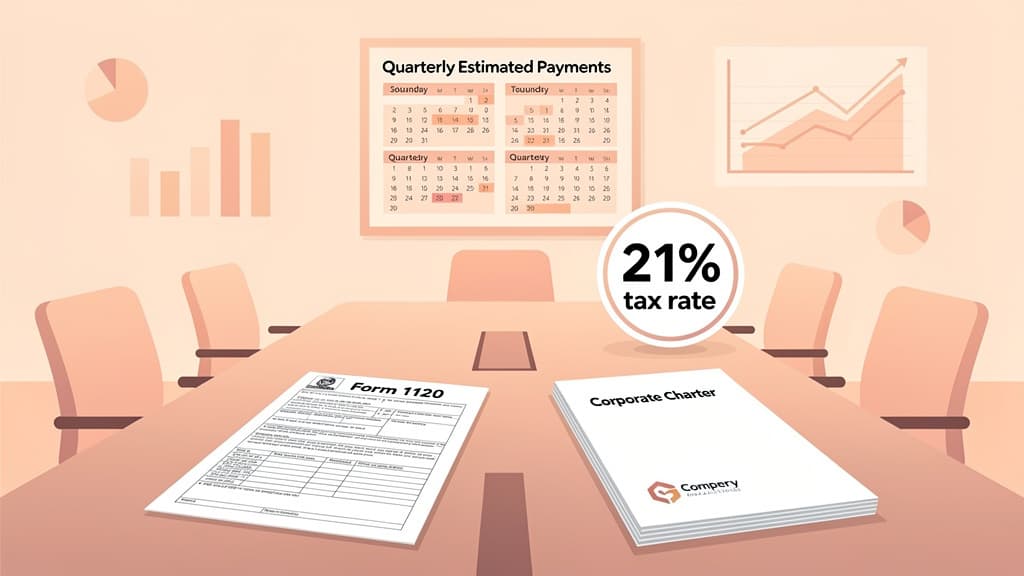
Every 2026 C-Corp tax deadline: Form 1120 filing, quarterly estimated payments (Q4 is Dec 15, not Jan 15), extensions, and the 21% flat corporate rate.

Every 2026 California tax deadline: FTB filing dates, franchise tax, LLC fees, estimated payments, PTE elections, and extensions for individuals and businesses.
New here? Enter this code at checkout and your first month is on us — full AI bookkeeping, tax filing, and a 24/7 accountant, $0 for 30 days.
New customers. First month free with code NEW2026, cancel anytime.
Join 1,000+ businesses using Jupid to save time and money. Start simplifying your finances today.
30-day money-back guarantee